Blazing Saddles
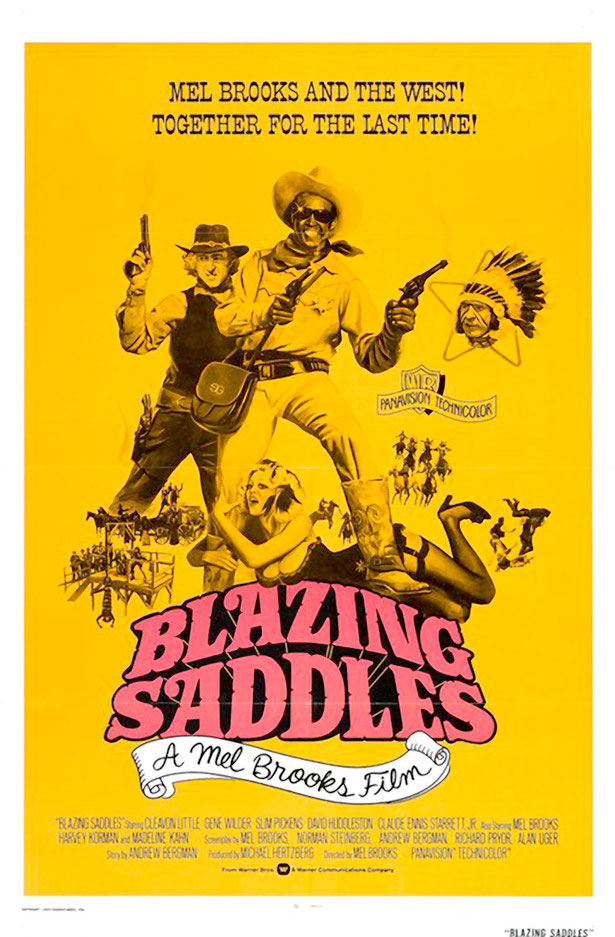 Once upon a time in the golden period of films known as the 1970s, Mel Brooks was, along with Woody Allen, the biggest directing name in comedy. Both had been on the legendary writing staff of Sid Caesar's Your Show of Shows in the '50s (along with Neil Simon and Carl Reiner) and both brought a distinctly Jewish tone to their slapstick. While Allen represented the Manhattan highbrow, Brooks’s style lurked more in the offensively low end Borscht Belt style. By the '80s, when Allen's status raised to the level of genius, Brooks’s comedy had already become passe and completely juvenile, working in the obvious (Spaceballs, Dracula: Dead and Loving It, etc.). But his early string of comedies, from The Producers through High Anxiety, created a lot of laughs, peaking in 1974 with two comic masterpieces: Young Frankenstein and, maybe even better, the bawdy western spoof Blazing Saddles.
The western spoof is almost as old as the western itself—you had Laurel & Hardy in Way Out West, The Marx Brothers in Go West, Mae West and W.C. Fields did My Little Chickadee, and Bob Hope had The Paleface and then Son of Paleface, not to mention Destry Rides Again with Marlene Dietrich (which Blazing Saddles actually directly spoofs). The '60s saw an examining of the western most directly through the Italian spaghetti westerns and American western comedies such as Cat Ballou and Support Your Local Sheriff! In the '70s, the reexamining went to the extreme as the western was turned in on itself and poked at by post-modernists with films as broad as Jodorowsky’s El Topo, Altman’s Buffalo Bill and the Indians, or Sitting Bull's History Lesson, to the sci-fi camp of Westworld. Blazing Saddles is more than a spoof; it’s one of the rare big laugh comedies that actually has something to say about contemporary racial politics, making it much closer to the later, intellectually ambitious films than the earlier yuk-fests.
Uncle Buck

Amidst all of the (well-deserved) praise for Judd Apatow's recent successes as a writer-director-producer, it is easy to lose sight of the fact that he's following a trail that was pretty well blazed by John Hughes twenty years ago. Like Apatow, Hughes made a name for himself by using a tight-knit group of collaborators to make a series of comedies that were at times slapstick, at times raunchy, at times high brow, and at all times built around a strong, essentially heartwarming story of personal growth.
Uncle Buck, Hughes' penultimate film, is a great example of this. John Candy, in one of his finest performances, plays Buck Russell, a proud bachelor that has built his life around having nothing and no one to weigh him down. After a family emergency, Buck is called upon to babysit his nephew Miles (Macaulay Culkin, at his most precocious) and nieces Maizy (Gaby Hoffmann) and Tia (Jean Louisa Kelly). He quickly gains the trust and love of the young Miles and Maizy, but teenaged neice Tia is old enough to recognize Buck for the black sheep that he is, and she intends to use Buck's stay as an opportunity to get away with things her parents wouldn't allow, especially with her boyfriend, "Bug."
Continue ReadingChinatown

This movie is not ranked on the top of AFI’s "Greatest American Movies" of all time for nothing. Every single aspect and element of this film - from its direction, cinematography, script development, performances, editing, to its art direction - is outstanding. When you take a director such as Roman Polanski, add a writer like Robert Towne, and have actors such as Jack Nicholson and Faye Dunaway, it’s almost a done deal. What leads this film to excel beyond excellence is its profound content and complex, multi-leveled storyline. Its underlying historical significance concerning the 1930s water rights in Los Angeles has also earned the film to be selected for preservation by the United States National Film Registry by the Library of Congress in 1991.
The story is set in the 1930s. J.J. “Jakes” Gittes, played by Jack Nicholson, is a Los Angeles private investigator hired by Evelyn Mulwray to spy on her supposed cheating husband, who is the city’s chief engineer for the water department. Soon after the initial investigation, Gittes finds that this woman is an impersonator of Evelyn Mulwray. He plunges into the case to discover the complex twists and turns of a murder involving incest and municipal corruption, which somehow all relate to the city’s water supply. How far do people in power go to keep themselves in that position? Follow Gittes’ investigation to find out.
Continue ReadingThe Day of the Triffids
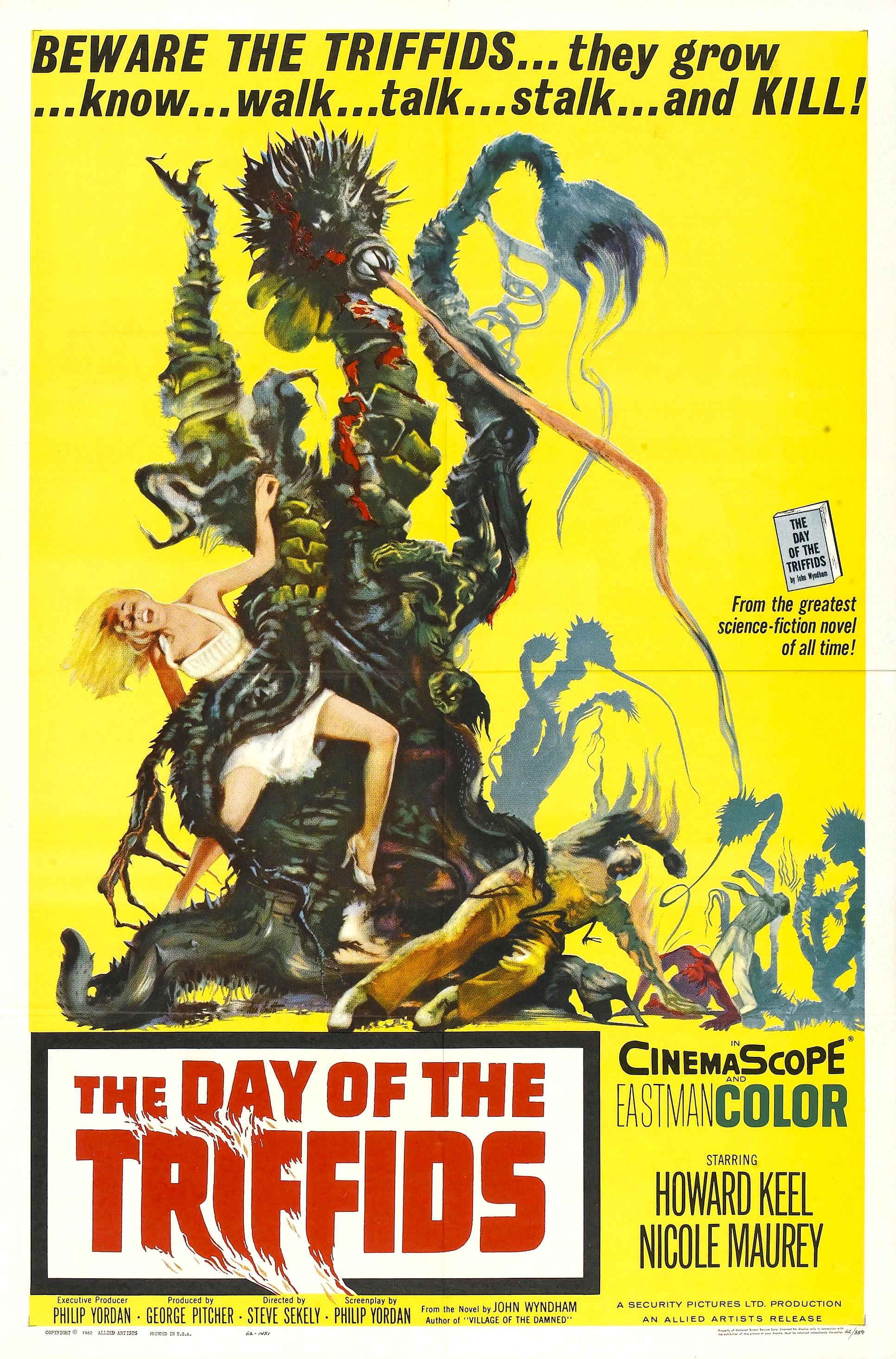 Though not in the same league with John Wyndham’s brilliant sci-fi novel that it’s based on, the low budget 1962 film version of The Day of the Triffids is still a heady piece of post-apocalyptic entertainment and still one of the best and most influential end-of-the-world films ever. A more faithful to the book version was made for BBC TV in 1981 and it’s also essential “survivor movie” viewing. (A more recent TV version in 2009 was terribly disappointing.) But while this first on-screen edition may veer from the book, it was a landmark in British B-movie sci-fi and in a lot of ways it still packs a wallop.
With all of London excited about watching an astounding meteor shower outside, American merchant seaman, Bill Masen (Howard Keel) is stuck in a hospital bed with his eyes bandaged after surgery. The next day he awakens to find that the hospital staff and then the entire town are now blind (everyone who watched the sky that night at least). If having to navigate among the desperately blind isn’t apocalyptic enough, it seems a deadly plant known as a Triffid is also on the loose—these are walking shrubs that shoot a poisonous stinger at their victims and if that’s not bad enough they have the ability to verbally communicate with each other. Eventually Bill comes across a little girl (Janina Faye) who can see and the two have to fight their way out of England and make it to France. Once there they help a group of blind women, including a pretty love interest (Nicole Maurey), while trying to escape a group of violent convicts as they head for Spain.
Hitchhiker's Guide To The Galaxy

The Earth was accidentally demolished to make way for a hyperspace bypass, and archetypal English bloke Arthur Dent was left hitching around the Galaxy with just his bathrobe, a towel, and a copy of the Hitchhiker's Guide (the one that has "Don't Panic" in friendly block letters on its cover.)
Welcome to the first full-length cinematic version of this 1980s sci-fi icon. And, since author Douglas Adams himself wrote the script, there is no reason to panic! The film is mostly harmless - eh, make that mostly delightful. Special effects range from a spacecraft that looks like a cannister vacuum cleaner turned inside out, to aliens from the Hanson Workshop who look like giant beanie babies. But the tour of the "factory floor" of Megrathea, the planet that manufactures worlds, is worth the price of the DVD. Adams included many of the skids, anecdotes and one-liners which made the book so special, and had them discreetly animated as well.
Continue ReadingStar Trek IV: The Voyage Home

We’ll never know for sure, but audiences may have fared better last year if Harrison Ford had directed the fourth Indiana Jones movie. Why not have let Mark Hammil try his hand at helming The Phantom Menace? Most fourth installments have little cinematic merit and do dismally at the box-office (Alien Resurrection, Batman and Robin, if you needed more examples.) So, if you’re a studio executive and you’ve still got three kids from two different marriages to put through college, what can you possibly do to make your third sequel work? Have a completely inexperienced lead actor from the franchise direct it, which is what happened when Leonard Nimoy assumed directorial duties for the second time on Star Trek IV: The Voyage Home, his first proverbial rodeo being Star Trek III: The Search for Spock. And here’s why Leonard could do what Steven, George, Jean-Pierre, and Joel could not: actors who are committed to the franchise have spent years reading scripts by other writers thinking, “If I was writing this, this would be so much better.” They’ve got a cache of ideas to benefit the series, rather than an interloping director approaching the project as an opportunity to put his mark on the franchise. The Voyage Home was the second highest grossing film of the series and a popular film with fans of the TV show and Star Trek neophytes alike.
The film documents a particularly bad day in the history of the Federation. Not only is the entire crew of the Enterprise on trial for disobeying orders and various assorted hijinks (plot remnants from the second and third films), the survival of Earth is threatened by a highly destructive alien probe that only speaks one language: humpback whale. Unfortunately, Earth’s largest mammals became extinct at the end of the 21st century. It looks like the probe’s unintentional annihilation of the planet is imminent, that is until Spock gets a wacky idea to time travel back in time to the 1980s and abduct some Earth whales to bring back to the future so they can tell the probe what it can do with itself, in whale song. The highly likeable middle section of the film takes place in modern day San Francisco and employs the person-from-the-future-out-of-water scenario to great comedic effect. The crew of the U.S.S. Enterprise’s talent for pitch-perfect timing and deadpan delivery is a welcome relief from the depressing eeriness of The Search for Spock. Dr. “Bones” McCoy is back to his sassy self after having spent the entirety of the previous film going crazy sharing his brain with Spock’s immortal soul and the writers allow themselves some political commentary by introducing some Cold War humor via Commander Pavel Chekov’s character. The ensemble’s ease with the material and their characters was undoubtedly facilitated by being directed by one of their own, and the atmosphere of relaxed bonhomie is reminiscent of the quality that made the Rat Pack so popular, but without the misogyny and the alcoholism. If you like laughs, good times, or both, Star Trek IV is a journey to the outer reaches of fun at warp speed.
Continue ReadingSunshine

Danny Boyle knows how to engage you. He knows, more than most other directors, how to scoot your butt to the edge of the seat, whiten your knuckles as they grip the armrest and give you a stress headache from furrowed brows. The man just keeps pushing it higher, faster, and closer to the edge. What edge? Any edge - that's the kicker - you don't know where the edge is or where it's coming from. It could be around the corner or RIGHT THERE. Seriously, you could fall at any moment.
Sunshine is a perfect heart pounding pulse kicking, monster mouth drying example. The stakes? Only the planet and all mankind. The risk? Dying alone in space in a myriad of painfully awful ways including murder and knowing in your last moments that history died with you.
Continue ReadingThe Fountain

I will always passionately love Requiem for a Dream. I will always passionately love Requiem for a Dream more than The Fountain. But I can't really compare Darren Aronofsky's two latest releases; it simply wouldn't be fair! The Fountain is a challenge that takes on a re-definition of science fiction, attempting to span 1,000 years and intersecting three parallel stories. It is certainly a task to admire. Aronofsky searches life's biggest questions - love, death, spirituality, existence - all while trying to go beyond typical science fiction films that were plot-driven by technology and science. He notes, "the interesting things are the ideas; the search for God, the search for meaning."
The film is personal and honorable in how simple yet intricate the story is. While I found it hard to involve myself in the more ancient sections of the film, and also thought using a cancer-stricken loved one as a character seems slightly redundant, but in the end mankind (in the general sense) is truly redeemed.
Continue ReadingBlade Runner: The Final Cut

What is “human?” That’s the basic question posited by Ridley Scott’s visionary science fiction opus, release in 2007 in a 25th-anniversary “final cut,” the director’s third pass at the film.
Based on a novel by Philip K. Dick and set in the dark, rain-soaked Los Angeles of 2019, the tale follows “blade runner” Deckard (Harrison Ford) as he pursues and attempts to terminate four “replicants” – genetically-engineered humanoids – who have violently escaped an off-world colony and returned to earth. Deckard becomes increasingly conflicted about his murderous job and doubtful about his own identity, as he falls in love with a replicant (Sean Young) and begins to realize that his prey may be more human than he believed.
Continue ReadingSolaris

Solaris was Tarkovsky’s first foray into Science Fiction. Tarkovsky was a big fan of soft science-fiction, the kind that deals with deep moral and philosophical questions instead of focusing on laser rifles, improbable monsters and shiny robots. The film is rather loosely adapted from a novel by Stanislaw Lem and, predictably, the end result was not to Lem’s liking, partly because Tarkovsky took the story and thoroughly made it his own while retaining aspects familiar to Lem’s fans.
The plot concerns a mission to a space station surrounding an oceanic world they’ve named Solaris. A psychologist, Kris Kelvin, is sent to assess the deteriorating situation on the station as scientists kill themselves and apparently go insane without fail. He is to return and recommend future action, possibly shooting radiation into the planet, possibly ending the experiment.
Continue Reading