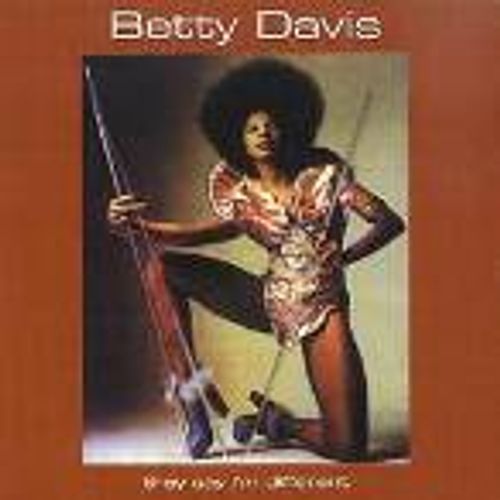
They Say I'm Different (CD)
Betty Davis

Track Listing
Disc 1 Titles |
Artist |
Length |
|---|---|---|
|
1.
Shoo-B-Doop And Cop Him
|
Betty Davis | 03:56 |
|
2.
He Was A Big Freak
|
Betty Davis | 04:06 |
|
3.
Your Mama Wants Ya Back
|
Betty Davis | 03:25 |
|
4.
Don't Call Her No Tramp
|
Betty Davis | 04:08 |
|
5.
Git In There
|
Betty Davis | 04:43 |
|
6.
They Say I'm Different
|
Betty Davis | 04:14 |
|
7.
70's Blues
|
Betty Davis | 04:59 |
|
8.
Special People
|
Betty Davis | 03:21 |
SHIPS FREE in U.S.
(1 Used)
(1 Used)
User Reviews
Overall Rating 1 Submissions
05/22/2013 While a title can be bestowed upon one, like a Dukedom or Barony, or can indicate ownership, like a deed, in the case of the second Betty Davis album, bemonickered They Say I’m Different, it’s nothing less than a manifesto. Sure there’s elements of influence (she’d already worked with the Commodores, Sly’s rhythm section, two thirds of the Band of Gypsys, Santanistas & future Journey-men), but all was realloyed in the confluence of Betty Davis in San Francisco in the early '70s. Though she’d done more conventional soul songs under her born name of Betty Mabry, by the time she helmed her self produced sophomore salvo, she was channeling all manner of current currents in the same slurry that spawned Malo, Cold Blood & Tower of Power. Having dispensed with external interference, Betty lays down the mojo solo, scatting and beat boxing the parts to hands she’s wrangled in to manifest her muse. The science of her sorcery’s revelated straight up and down on “Git In There” (thoughtfully doubled up, along with “He Was A Big Freak,” “Don’t Call Her No Tramp,” and “70’s Blues,” in alternate versions, by the stellar fellas at Light In the Attic). Kicking in with a throaty chortle, Betty show and proves her down South roots with a molassed preambling ramble, shlurred and swaggering, instructions and exhortations to the band and the audience ensuing. She is the message, the music the medium. Blacklisted, backlashed, and lambasted for the recognition of universal sufferation in “Don’t Call Her No Tramp,” she could as easily be speaking of her own sicheeation, a black woman riding for her own nature and aligned to freedom, eternally subject to the right brigade’s hoots of "jezebel" and "loose."
But, maybe there’s truth in small minds’ mentations, as grooves don’t get much looser than the ones on "Shoo-B-Doop and Cop Him" or the wantonly joyful lack of constraint on "He Was a Big Freak." So relax yourself, let your conscience be free and get down to the sound of B-E-T-T(y) (propers and apologies to EPMD).
05/22/2013 While a title can be bestowed upon one, like a Dukedom or Barony, or can indicate ownership, like a deed, in the case of the second Betty Davis album, bemonickered They Say I’m Different, it’s nothing less than a manifesto. Sure there’s elements of influence (she’d already worked with the Commodores, Sly’s rhythm section, two thirds of the Band of Gypsys, Santanistas & future Journey-men), but all was realloyed in the confluence of Betty Davis in San Francisco in the early '70s. Though she’d done more conventional soul songs under her born name of Betty Mabry, by the time she helmed her self produced sophomore salvo, she was channeling all manner of current currents in the same slurry that spawned Malo, Cold Blood & Tower of Power. Having dispensed with external interference, Betty lays down the mojo solo, scatting and beat boxing the parts to hands she’s wrangled in to manifest her muse. The science of her sorcery’s revelated straight up and down on “Git In There” (thoughtfully doubled up, along with “He Was A Big Freak,” “Don’t Call Her No Tramp,” and “70’s Blues,” in alternate versions, by the stellar fellas at Light In the Attic). Kicking in with a throaty chortle, Betty show and proves her down South roots with a molassed preambling ramble, shlurred and swaggering, instructions and exhortations to the band and the audience ensuing. She is the message, the music the medium. Blacklisted, backlashed, and lambasted for the recognition of universal sufferation in “Don’t Call Her No Tramp,” she could as easily be speaking of her own sicheeation, a black woman riding for her own nature and aligned to freedom, eternally subject to the right brigade’s hoots of "jezebel" and "loose."
But, maybe there’s truth in small minds’ mentations, as grooves don’t get much looser than the ones on "Shoo-B-Doop and Cop Him" or the wantonly joyful lack of constraint on "He Was a Big Freak." So relax yourself, let your conscience be free and get down to the sound of B-E-T-T(y) (propers and apologies to EPMD).