Strangers on a Train
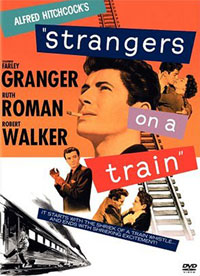 Coming off a string of underwhelming flicks (The Paradine Case, Under Capricorn and Stage Fright), Alfred Hitchcock would kickstart a decade of unparalleled creativity with Strangers on a Train, a nasty little piece of amoral pulp, delightfully mean spirited and loaded with cruel dark humor. This is textbook Hitchcock, full of as many classic set-pieces as any of his films and a must for anyone who wants to learn about the simplicity of creating genuine tension from dynamic camera moves and clever editing. Besides the master director, the other highlight of the film is Robert Walker who gives the performance of his short career as the one of the great conniving psychopaths in film history. Unfortunately not long after the film was completed Walker died, at the age of 32, from an apparent fatal combination of alcohol and prescription drugs. Also of note, any documentary or academic study on the history of homosexuality in film will certainly cite Walker’s character’s obvious closeted sexuality (and maybe for shame because, like many gay characters on the screen back then, his possible homosexuality is linked to his disturbed nature).
The beautifully crafted screenplay is credited to two nobodies (Czenzi Ormonde and Whitfield Cook) and the great crime writer Raymond Chandler (Double Indemnity, The Big Sleep). It was based on a novel by Patricia Highsmith whose series of books about the psycho Tom Ripley was the source for the excellent Hitchcockian French thriller Purple Noon as well as the notable The American Friend and The Talented Mr Ripley. Instead of Ripley, the deadly mind at work here is Bruno Anthony (Walker). When Bruno recognizes a local tennis playing celebrity, Guy Haines (Farley Granger), on an East Coast train, he seems to know everything about the guy. Bruno is fully aware that Guy is stuck in a loveless marriage to the frosty Miriam (Laura Elliott) and wants to get rid of her so he can upgrade to the more beautiful Anne Morton (Ruth Roman), who comes from a respected rich family which could help in Guy’s future prospects. Bruno suggests to Guy, hypothetically, they do “criss-cross murders” - Bruno will bump off Miriam and Guy can kill Bruno’s father for him. Since they don’t know each other, they would never be suspects. Guy excuses himself from the stalker, but for Bruno, maybe this wasn’t hypothetical.
Some Like It Hot
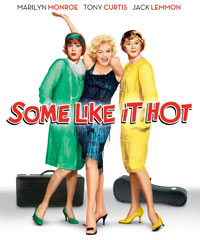 Easily the best drag-comedy ever made, nudging just past Tootsie, Some Like It Hot confirms that Billy Wilder was one of the two greatest directors in America of his generation, alongside fellow non-American born filmmaker Alfred Hitchcock. Besides its ranking as a terrifically entertaining comedy, it also has cultural importance as the best flick Marilyn Monroe had starred in (she only had one scene in the masterpiece All About Eve). Following her earlier collaboration with Wilder, The Seven Year Itch, this film was sold to the public as a Monroe vehicle. She handles the comedy splendidly and oozes sex deliciously (in some outfits that even by today's standards would be considered kinda hootchie), but it’s the rest of the cast that Wilder surrounds her with who make it more than just your average sex farce. Pretty boy Tony Curtis and young funnyman Jack Lemmon (who won an Oscar a few years earlier for Mister Roberts) are exceptional spending a majority of their on-screen time dressed as women. There’s also gangster tough-guy, George Raft (a sorta comeback for him), bizarre super-ham Joe E. Brown (who you could say steals the film), and the great journeyman character actor Pat O’Brien rounding out the cast. Wilder co-wrote the script with I.A.L. Diamond for the second time after Love In The Afternoon and together they create real magic; taking a plot that would be considered a third tier sitcom idea and ended up setting the blueprint for what is now considered a perfect and smart comedy. Wilder and Diamond would go on to collaborate on ten more films together, including The Apartment, but Some Like It Hot is the script that still influences films today (not that Cameron Crowe and others haven’t ripped off The Apartment a number of times).
Opening like a send up of Warner’s black & white gangster films, it’s 1929 Chicago and the town is jumping. At a speakeasy, two musicians, Joe (Curtis) and Jerry (Lemmon), are in a dire financial predicament, especially when their latest gig is broken up by a police raid. Under their nose Detective Mulligan (O’Brien) is busting big time underworld figure Spats Colombo (Raft, back in his full mean gangster persona), which leads to the now famous Saint Valentines’s Day Massacre (where a bunch of gangsters got machine gunned down in cold blood). Unfortunately Joe and Jerry witness it and now have to go on the run. Solving both their financial problems and a way to hide out, they join an all girls band heading to Florida (completely wigged, made-up and dolled out). Now under their new female aliases Josephine and Daphne, they take a long train ride South with their new band, both becoming infatuated with their ditzy new lead singer, Sugar (Monroe). In awe of her sexy, curvy walk and insecure about their new guise, Lemmon declares the obvious, “I tell you, it’s a whole different sex.”
Notorious
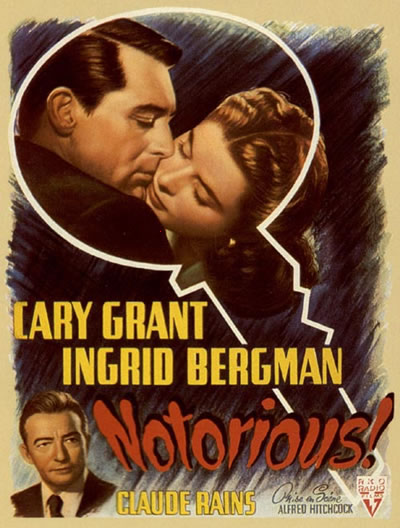 The massive career of Alfred Hitchcock can be broken down into three sections. There’s his early British career (that includes both silent films and talkies) that ends with Jamaica Inn in 1939. Then there’s the first half of his American period; he crossed the ocean and found instant success with Rebecca and continued to hone his craft and try out different genres during the 1940s and early ‘50s. And then finally there’s his most celebrated period beginning around ’54 with Rear Window and Dial M for Murder, where the name Hitchcock became a brand and most of his films were events in themselves. Of that middle period, besides Rebecca there are a number of celebrated and still admired flicks including Spellbound, Shadow of a Doubt, and Strangers on a Train. But one film that really stands out, less flashy than the others but more emotionally devastating, is Notorious. On paper it’s an espionage thriller, but it’s actually one of the great heartbreaking love stories of the era.
Just after WWII, Alicia Huberman (Ingrid Bergman), the party girl daughter of a convicted Nazi spy, is recruited by an American Intelligence agent, T. R. Devlin (Cary Grant), to prove her love to the red, white, & blue by infiltrating a group of Nazis who are hanging out in Brazil, planning a little postwar revenge against the USA. Things get complicated when, while waiting for the job to start, the two beautiful people fall in love. When the details arrive, it’s ugly; she has to go seduce an older ex-boyfriend, Alex Sebastian (Claude Rains), and find out what he and his cronies have in mind. She desperately wants Devlin to stand by and trust her; but though he does genuinely love her, he’s too cool to put down his guard and too professional to stop his bosses from deploying her. Still hoping to end up with Devlin, the dutiful Alicia takes the job and seduces Sebastian so well that he asks her to marry him, even while knowing she may be setting him up. It’s a love triangle, but in a twisted kind of knot that only Hitchcock could devise.
The Heiress
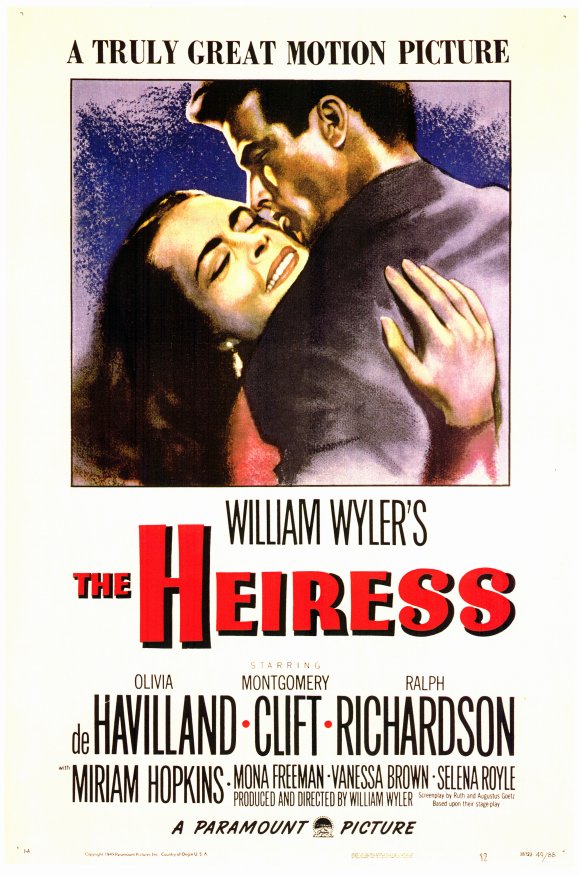 In some ways Olivia de Havilland may be one of the more underrated actresses of her generation. She wasn’t as iconic as some of her peers like Katharine Hepburn or Bette Davis and not quite as beautiful as her rival sister, actress Joan Fontaine (Suspicion); instead of sexiness de Havilland brought a righteous intelligence to her roles. She was known throughout history mostly for playing Melanie in Gone with the Wind and for her association with the dashing actor Errol Flynn in their eight films together, most notably The Adventures of Robin Hood, They Died with Their Boots On, and Captain Blood. She had a number of other relevant roles in the ‘40s including The Snake Pit, Not as a Stranger, and Hold Back the Dawn. de Havilland won two Oscars: first, for the melodrama To Each His Own and then for her most interesting performance in William Wyler’s The Heiress, based on the Henry James novel Washington Square.
The late 1800s in New York City: mousy spinster Catherine Sloper (de Havilland) lives with her wise and widowed doctor father, Austin (Ralph Richardson who in real life was only 14-years-older than de Havilland), and her doting aunt, Lavinia (Miriam Hopkins). Catherine’s utterly plain and shy and unexceptional in every manner, which makes it more surprising when the handsome Morris Townsend (Montgomery Clift) shows up in town from California and immediately takes an interest in Catherine, wooing her with all his pretty-boy charms. Romanced for the first time, Catherine comes alive, becoming a giddy school girl utterly smitten with her suitor. The two lovebirds become engaged and plan to elope, but Austin doesn’t trust the rogue, knowing a playboy gold digger when he sees one; he tells Catherine he will disinherit her if she marries him. He also hurts his daughter when he coldly explains that Morris could have any young hottie in NY and why would he chose her if it’s not for the money? Proving Dad right, with the money not coming Morris doesn’t show up for the elopement and rushes back to California. Brokenhearted, Catherine realizes for the first time she really is a dullard who can only find love if she’s loaded with cash. And then to make matters worse, Austin dies and Catherine goes from a happy simpleton to a cold heiress. Years later Morris returns to try and get in on the money again, but the new self-empowered Catherine only pretends to buy into his oily trap and turns the tables on him instead, accepting a lifetime of loneliness to keep her dignity.
Seven Days in May
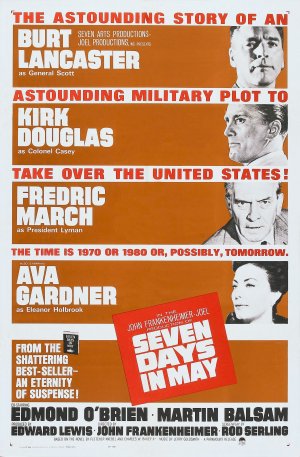 With the Cold War in full swing, the saga of President Kennedy peaking, another potential war in Asia, and nuclear proliferation moving at a rapid pace, the early ‘60s inspired a slew of solid political flicks. From nuclear madness came Fail-Safe, Dr. Strangelove, and On the Beach. Political soap operas inspired Advise & Consent and The Best Man and from those, the deep paranoia of the right, and the “military industrial complex” came director John Frankenheimer’s twisted, sorta sci-fi nightmare, The Manchurian Candidate. For Frankenheimer’s follow-up he would combine all the genres (nukes, politics and right wing paranoia) for the slick White House thriller Seven Days in May which features Burt Lancaster and Kirk Douglas appearing together for the second time, after Gunfight At The O.K. Corral (not including Lancaster’s cameo in The List of Adrian Messenger). Just as he did brilliantly in Sweet Smell of Success this time Lancaster took the supporting bad guy role. It’s a great showdown between two of Hollywood’s most sculpted physiques of their era.
Based on a novel by Fletcher Knebel and Charles W. Bailey, Douglas plays Colonel Martin "Jiggs" Casey, a Pentagon Joint Chiefs of Staff aide to the powerful James Mattoon Scott (Lancaster). Jiggs is a moderate, more devoted to upholding the Constitution than playing politics, but the guys above him are stone-cold hawks and don’t like it when liberal President Jordan Lyman (Fredric March) signs a nuclear disarmament agreement with the Soviets. Reading cables, hearing secondhand conversations, and finding an incriminating crumpled note leads Jiggs to deduce that Scott is planning a military coup against The White House. He takes his suspicion directly to the president and then begins a cat and mouse game of cloak n’ dagger, teaming with the most trusted members of the president's inner circle, including his top aide, Paul Girard (Martin Balsam), a crusty drunken Southern congressman played wonderfully by Edmond O’Brien (he won an Oscar ten years earlier for his performance in The Barefoot Contessa), and finally Jiggs cozies up to a boozy Washington socialite, Eleanor Holbrook (Ava Gardner), who knows all the town’s players and harbors secrets.
Miracle on 34th Street
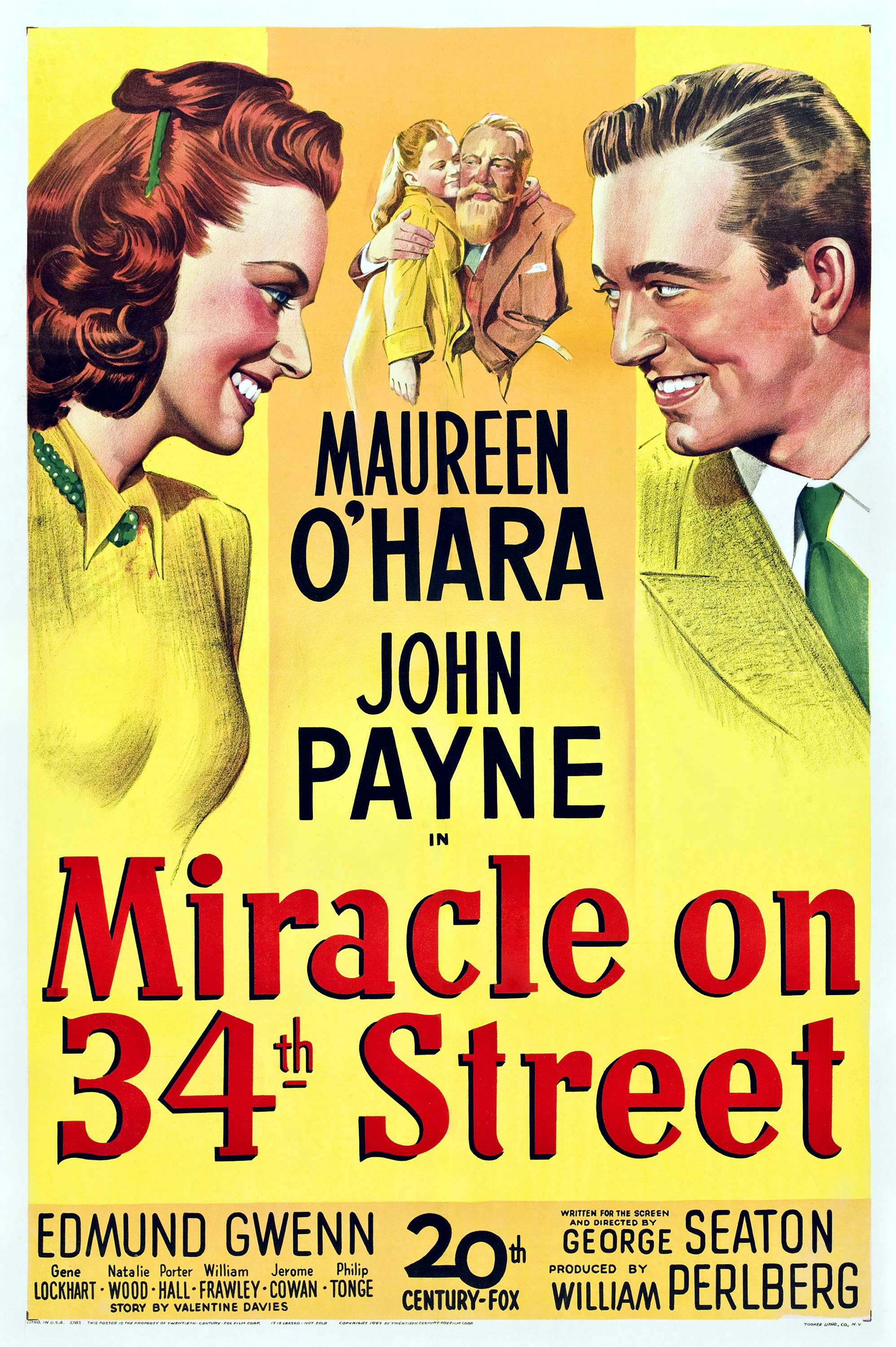 No other film in history has been able to capture the spirit of Christmas and toss cinders on the commercialism that the holiday has come to represent quite like Miracle on Thirty-Fourth Street. At 60-something-years-old, the film is still just as relevant, funny, and, ultimately, moving as it ever was. Like How the Grinch Stole Christmas (the original animated version), It’s a Wonderful Life,and the more recent A Christmas Story, Miracle on Thirty-Fourth Street has become standard, even compulsive, viewing during the holiday season. Today’s kids may think that Christmas is some kind of video game or a season to shop and spend money, but Miracle on Thirty-Fourth Street has reminded generations what it’s supposed to be about. As Mr. Kringle says in the film, “Christmas isn’t just a day; it’s a frame of mind.”
The beautiful but icy Doris Walker (Maureen O’Hara) is a cynical single mom who works for the glamorous Macy’s Department Store in New York City. While handling the big Thanksgiving Day Parade she pulls a bearded old man (Edmund Gwenn) off the street to play Santa Claus. The twist is he actually claims to be the jolly toy maker and even calls himself Kris Kringle. The good-natured, but possibly delusional, old coot is so convincing Macy’s hires him to be their full-time in-store Santa. Meanwhile, Doris’s daughter, Susan (Natalie Wood), is her mom’s mini-me, with equal disdain for childish things like make-believe. But when she befriends her do-gooder neighbor, a bachelor lawyer with the unfortunate name of Fred Gailey (John Payne), he encourages her to start to act like a kid and gets Doris to instantly open her heart to romance. All three befriend Kris, while he and Fred try to loosen up the two uptight females. Little Susan is taken aback when she see Kris speak Dutch to a peewee foreign girl, giving her the idea that maybe this guy is the real deal.
Billy Liar
 Set in the rapidly changing times of 1960s England, Billy Liar tells the story of a young man who's impervious to change and weak from imagination. Most teenagers go through a phase of deception—one in which they exaggerate their circumstances and experiences in order to get respect and acceptance from their peers. Young boys and girls brag about certain sexual encounters or invisible spouses, or some claim that generic items bought on sale were expensive. These claims at excellence are sometimes made out of boredom, but oftentimes are done just for the chance to exercise their imaginative muscles. When they reach adulthood, these traits are usually written off as juvenile and grown-up mentalities eventually set in. Our protagonist, Billy Fisher (Tom Courtenay), is one of those young adults who can't seem to make that transition.
His town accentuates his conflicting views towards change and offers a great metaphor. The majority of the people there don't change, nor do they stray from their safety zones as far as relationships and employment. Housewives wait on edge to see if someone has dedicated a song to them on the popular radio station, “Housewives’ Choice.” Young men scuffle for employment and young ladies work towards becoming their future housewives. But as these people carry on their daily routines, change invades them via demolitions of prized structures and the increase of blacks in many positions. Billy is constantly trying to play by the rules and bend them at the same time, but what he really wants to do is tear down the entire foundation and start anew.
The Wild One
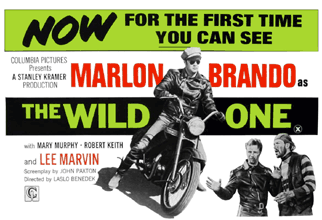 Though that amazing string of performances in A Streetcar Named Desire, Viva Zapata!, Julius Caesar, and On the Waterfront earned Marlon Brando four straight Oscar nominations (finally winning for Waterfront) and made him the most celebrated acting talent of his generation, it’s actually his work as Johnny in The Wild One that made him an icon of rebellion and helped inspire the youth culture that was just beginning to emerge in America (and abroad). The Wild One was the first “biker picture” to penetrate mainstream consciousness, a genre that would become very popular in independent film ten lean years later.
Though produced by issue-director/producer Stanley Kramer, giving the film an overly dramatic “this is important” vibe, it’s actually a really fun B-movie, carried by Brando’s cocky performance. His Johnny leads his biker gang almost like a cult leader. The gang, with their rowdy antics, tries to impress their messiah, but Johnny, with his southern/ be-bop accent, is a man of few words. Hitting the road looking for kicks, Brando and his gang stumble on a small town where they instantly catch the attention of the law and some uptight citizens, and a saloon owner invites them to stay for beer and sandwiches. The innocent young barmaid Kathie (the very beautiful Mary Murphy) catches Johnny’s eye. It doesn’t help when he declares “I don’t like cops,” even though her dad is the town’s sheriff (Robert Keith, father of Brian), and is actually very evenhanded and sympathetic to Johnny and his pals.
Anatomy of a Murder
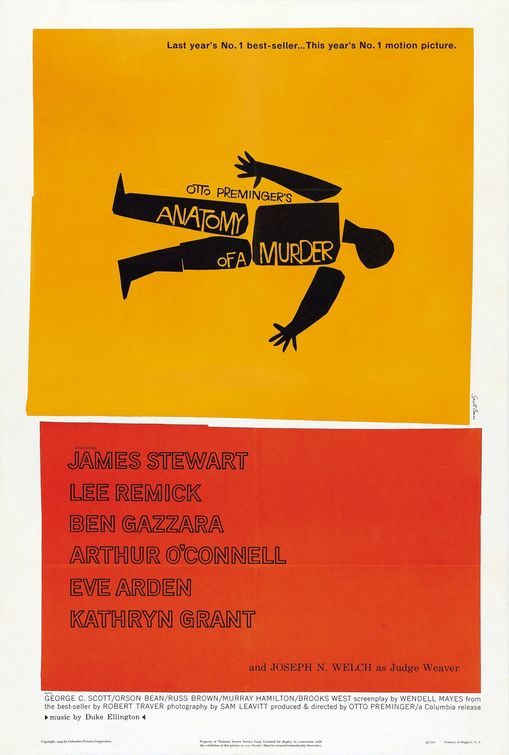 Director Otto Preminger seemed to look for controversial subjects all through his career but with his two hour and forty minute courtroom masterpiece Anatomy of a Murder, he might’ve gone farther than 1959 audiences could handle. The film is about a lawyer defending a man who’s accused of killing a guy who possibly raped his wife. If that wasn’t lurid enough for audiences, they especially got all angsty over a word that was repeated in the trial, that horrific word…. “panties” (you know, women’s underwear). For anyone who can get past such a lewd word, Anatomy of a Murder is very dense in detail, almost an epic in just exploring the small details of a legal case. And it’s still one of the best lawyer flicks ever.
The film is loaded with talent on both sides of the camera including a famous title sequence by Saul Bass (Psycho) and a catchy score by Duke Ellington (strange since the film takes place in Michigan’s Upper Peninsula—not exactly a “jazzy” part of the country. Also, Duke appears in a cameo as well.) Michigan Supreme Court Justice John D. Voelker wrote the book based on a real life case; the script was shrewdly adapted by Wendell Mayes (The Poseidon Adventure, Death Wish). It’s also shot in cool black & white by the dependable cinematographer Sam Leavitt (A Star Is Born, Exodus, Major Dundee) and it was edited by another pro, Louis R. Loeffler (Laura, The Long Hot Summer). And of course director/producer, the Hungarian-born Preminger himself, was one of the big guns of his era, with a directing career going back to the Noir period (Laura, Whirlpool). Anatomy of a Murder was easily his best film but everything he did, no matter the overall quality, was always interesting.
A Night At The Opera

The Marx Brothers - Groucho, Chico, and Harpo - were actual brothers (their early stage act included another brother, Gummo, and in a couple early films he was replaced by Zeppo). Going from Vaudeville to Broadway then to the big screen, the Marx Brothers were a completely original act. Their formula, which is still in use today, was the classic snobs vs. the slobs, but what really made them memorable was the mix of smartass one-liners (from Groucho and Chico) and fantastic physical comedy (usually associated with the mute Harpo). After a half dozen films that progressively got better they really hit their stride with Duck Soup in 1933 and then made their true masterpiece with their next film, A Night At The Opera, a perfectly subversive film and still one of the funniest screen comedies of all time.
Groucho plays Otis B. Driftwood, a con man working the Opera scene in Italy. He is hired by the clueless widow, Mrs. Claypool (Margaret Dumont), to help her break into proper society. Meanwhile the egomaniacal star of the opera, Lassparri (Walter Woolf King), abuses his dresser (Harpo) and sexually harasses the company’s young ingénue, Rosa (Kitty Carlisle), who is in love with the less successful, but equally talented tenor, Riccardo (Allan Jones, playing the Zeppo, straight man role). Riccardo is managed by Fiorello (Chico) who hustles Otis into signing him to a contract. As the opera company sets sail to New York the three Marx Brothers follow it in order to help the young lovers reunite, make some cash, and bring down the arrogant Lassparri.
Continue Reading