Last week ‘the father of surf films,’ Bud "Barracuda" Browne, the onetime lifeguard who began showing his 16-millimeter movies commercially in the early 1950’s, died in his sleep at his home in San Luis Obispo. He was 96.
Born July 12th, 1912, in Newtonville, Massachusetts, Browne began swimming competitively at age seven. He attended USC, was captain of the swim team and in 1933 ranked second in the nation as a collegiate swimmer. While working as a lifeguard at Venice Beach in late thirties, Browne was introduced to surfing. In 1938 he went to Hawaii to ride the big waves in Waikiki, taking along an 8-millimeter movie camera to film the local surfers. One his first and most prized reels of film recorded the legendary king of the surfers Duke Kahanamoku.
During World War II, Browne served as a navy chief specialist in athletics (earning the nickname "Barracuda" for his long lean look). Following the war he became a teacher in Los Angeles, working as a middle-school physical education instructor and also attended USC Film School. He upgraded his camera to a 16-millimeter Bell & Howell. In 1953, after spending several years filming surfers in Hawaii, Browne pieced together enough footage to compile a 45-minute film. Hawaiian Surfing Movie debuted at John Adams Middle School in Santa Monica.
Browne eventually gave up his teaching gig and took to chronicling the 1950’s surf scene full time, releasing at least one movie a year between 1953 and 1964. With films such as Trek to Makaha, The Big Surf, Surf Down Under, Cavalcade of Surf, Locked In and Gun Ho!, Browne documented all the surfing greats of the longboard era, like Phil Edwards, Buzzy Trent, Greg Noll, Miki Dora, Linda Benson
and Dewey Weber, plus the first-generation of shortboard riders, like David Nuuhiwa, Nat Young and Gerry Lopez. In addition to completing nearly 20 of his own films, he also contributed footage to other projects such as Big Wednesday, directed by John Milius, Greg McGillivray/Jim Freeman’s Waves of Change (also known as The Sunshine Sea) and their 1972 classic Five Summer Stories. In the early 1990’s Browne began re-editing some of his earlier efforts. The first project, Surfing the 50's, honed his best color footage from the eight films he produced during the fifties. That success led to re-releasing some of his other movies such as the 1963 classic, Gun Ho!.
Bud Browne 1912 - 2008
The father of surf films
NYC EXTREME SPORTS: YOU COULD DIE
THE BROADWAY BOMB & SUBWAY SURFING
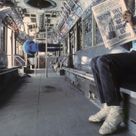
Recently in New York City a 21 year old "subway surfer" was killed after getting bounced off a moving C line train. Subway surfing is the dare-devil stunt that involves riding either atop or clinging to the side of a moving train. While popular in certain South American and European cities (including in Denmark, where the documentary excerpt below is from), it has only been sporadically popular in New York City's MTA (Metropolitan Transportation Authority) subway system over recent years, and for good reason. The stunt has a very high probability of ending in fatal disaster due to the tight space between the train and the MTA tunnels. Unlike in other foreign cities, where the trains are mostly outdoors, the MTA run mainly through underground tunnels. Four years ago there were several subway-surfing fatalities on New York's subway system within a short time span -- apparently inspired by some publicity about the practice at that time. Since then, the MTA has initiated a campaign educating those foolish enough to try surfing a New York subway car.

In comparison, the relatively tame, although still illegal and dangerous, annual Broadway Bomb -- a race in which about a hundred daredevil skateboarders roll from uptown to downtown Manhattan along Broadway from 116th Street all the way down to Bowling Green, which is eight and half miles, dodging cars, buses, and taxis and ignoring traffic lights along the way -- went without incident two Sundays ago in New York City. And even though the motto for the event is "You could die," no one has so far. But then, the event is held on a Sunday when there is very little traffic in NYC compared to weekdays. There is also talk that the event, which already has sponsors, may soon become legit.
UNDERDOGS, COMMON THEME IN DOUG PRAY'S FILMS
Hype!, Scratch, Infamy, Big Rig, and Surfwise - all contain theme of outsiders

Los Angeles based documentary film-maker Doug Pray (Hype!, Scratch, Infamy)'s latest release is Big Rig, a documentary about the subculture of contemporary truck-drivers. The film premiered at Austin's SXSW fest in March. Pray's latest production, Surfwise, is a documentary about the dynamics of a unique surfing family. The filmmaker says that the distinct common thread between each of his documentaries is that each tells the story of misunderstood individuals. "They're all subcultures... groups (that) have been misperceived. I see their characters as underdogs," he said. His first film was the 1996 documentary Hype!, which was literally about the hype behind the North West's underground "grunge scene" and how exactly that music was transformed, neatly packaged, and sold to the gullible masses. His next and even better known film (which won numerous awards) was Scratch, about the the rise and history of the hip-hop DJ/turntablist. It was followed by Infamy, a documentary about six graffiti artists plus one anti-graffiti activist.
To director Pray there is an obvious common thread between each of the films' subjects. Speaking of Hype!, Scratch, and Infamy, he said, "They're all subcultures which I never set out to do but it is interesting how things turn out. All three groups were misperceived in general and I think that's what's in common with all three. Like the way people in Seattle felt that their movement had been packaged and kind of sold to the masses as something that it wasn't -- that was a reason to make a movie because I was there and I thought 'You know what?' What the world thinks about this music community is not what they're saying it really is!' Same thing with the deejays in Scratch. It was sort of like everybody, as in mainstream America, thought they knew what hip-hop was and what the hip-hop DJs were saying was really different from this perception...It's all the same thing -- same thing with Infamy about the graffiti artists."
Before he began shooting the director mistakenly thought that Infamy would turn out to be an upbeat celebration of bright, beautiful graffiti art. Instead, it turned out be an engrossing, dark portrayal of obsessed artists who commit felonies, constantly risking jail time just to create their art. "Graffiti artists are manic depressive," confesses graffiti artist Saber in one engaging scene. Infamy is unlike other graffiti films. "Most graf films are made in such earnest from a graffiti art fan's perspective that they often overlook the human element," said Pray, who deliberately limited the number of subjects profiled in his film. "I didn't want to have 30 artists in there and just get to know a little about (each of) them. I wanted to really focus on just six artists. I wanted to make a movie where you really got to know the person, their family, their peers, their crew...One of the differences with graffiti and others is that it is really demented...It is an obsession and it is both very stimulating and it leads to trouble...it is unlike any other art because it is a felony."