Roughly occurring at the same time as the more well-known and more celebrated French Nouvelle Vague (or New Wave), another group of frequently collaborative film-makers were grouped together under the moniker "Rive Gauche", named after Paris' artsy side. These film-makers (Agnès Varda, Chris Marker, Jean Cayrol, Henri Colpi, Marguerite Duras, Alain Robbe-Grillet,) applied to film the concepts which defined the Nouveau Romain in contemporaneous literature. Duras and Robbe-Grillet were also writers and associated with the literary movement in which experimental authors sought to create a new style with each work. Together, they produced an amazing body of film which remains largely overshadowed by the much more popular New Wave, though no less interesting or significant.
Because of the film-makers' approach to art and their being French, as well as contemporaries of the New Wave, they're often lumped in with them even though the New Wave which, while radically experimental, was more stylistically consistent due its focus on the director as the film's author. Ironically, the New Wave view served to encourage the personal and recognizable authorial nature of film, whereas members of the Rive Gauche often sought to depersonalize their works in an attempt to defy expectations, placing them in polar opposition in this regard.

Alain Resnais began making films in the 1940s. He is best known for his films Nuit Et Brouiilard (1955), Hiroshima Mon Amour (1959) and L'Anee Derniere a Marienbad (1961).
Nuit Et Brouillard stands alone in cinematic history in its depiction of the Jewish Holocaust. Resnais avoided the familiar black and white stock-footage for most of the film and instead presented tranquil scenes of the by-then abandoned concentration camps in color, with flowers growing through the cracks and sun beams shining on the desolate remains. Compare, for example, Nuit Et Brouiilard to a cinematically conservative film like Schindler's List. Spielberg chose to film in black and white (both literally and morally), with big name actors and with action unfolding in a familiarly un-ending winter that makes the events seem cliche and safely remote.

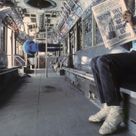
A segment of Sans Soleil
Chris Marker (born Christian François Bouche-Villeneuve) began making films in the 1950s but made his most well-known film, La Jetée in 1962. Constructed almost entirely (all except one shot) of still photos, it uses photomontage to tell its story, which inspired both Mamoru Oshii's Akai Megane and Terry Gilliam's 12 Monkeys. 1983's Sans Soleil [along with Godfrey Reggio's Koyaanisqatsi: Life out of Balance (1982)] are credited with the creation the film genre known as the "Essay Film" which refers to films on the experimental edge of documentary where visuals and music convey a somewhat abstract thesis without relying on talking heads, interviews, or the Ken Burns effect. Instead of relying on participants, the film itself is the argument.
Marguerite Duras was born in French Indochina. Her early writings were more traditional and sometimes disparaged by her peers for their Romanticism. She wrote the screenplay for many films including Hiroshima Mon Amour and Tony Richardson's Mademoiselle. 1992's The Lover was based on one of her novels. None of the films which she directed are currently available on DVD.

Jean Cayrol wrote the narration for Nuit et Brouillard and the screenplay for Muriel Ou le Temps d'un Retour. He was best known for his poetry and only directed one film, 1965's Le Coup de Grace.

A scene from La Belle Captive

Alain Robbe-Grillet is primarily recognized as an author of books. However, he wrote the screenplay for L'année dernière à Marienbad and directed films as well, although the only directorial work of his currently available on DVD is La Belle Captive.
L'année dernière à Marienbad, in keeping with the desire to create a new style with each work, is a bizarre, dream-like film that bears little similarity to Nuit et Brouillard. It defies recognizable narrative and is impossible to make absolute sense of. Because of its baffling and distant nature, it's often disparaged for being ridiculously serious. I personally find it sort of perversely humorous but it really is ultimately inscrutible, which has (along with its striking style and stone-faced characters) inspired many homages, imitations and parodies that have come to define many people's conception of foreign film.
The trailer to Cleo de 5 a 7


When I was on a phenomenology kick, reading Merleau-Ponty et al., I came across Robbe-Grillet's JEALOUSY, a novella which attempts to tell a narrative through objects. It reminded me of what I didn't (and still don't) like about hard-sf, those endless pages of techno-babble descriptions of gadgets (e.g., Frank Herbert) -- I prefer the thought-experimental style of Ballard's shorts or Lem's robot stories. In a funny sort of way, Robbe-Grillet's phenomenological writings share with hard-sf writers a realism in extremis -- sheared of the moralism of realists like Bazin and lost in the world of object fantasies. Nevertheless, Robbe-Grillet makes for great theorizing. Marker, Varda and particularly Resnais are all great after the fact, too.